Tapo's Best Outdoor Security Cameras for Home (2026)
You're not home, but life keeps happening outside your front door. A package gets left on the porch. A car pulls into the driveway, and you're not sure whose it is. These are the everyday moments that make people start thinking about outdoor cameras. Finding the best outdoor security cameras for home use doesn't have to mean wading through spec sheets. It means finding a camera that fits where you need it and does what you actually need it to do.
This guide covers what features matter for outdoor use, how to match a camera to your setup, and which Tapo options stand out for different situations. All core features are included without a subscription, and local storage on a microSD card (sold separately) lets you save footage without ongoing fees.
Key Takeaways
- Start with location, power source, and how much detail you need before comparing specs or models.
- Higher resolution and pan/tilt coverage help you identify people and vehicles at a distance, most useful for driveways and large yards.
- Wired cameras provide uninterrupted recording from an outlet; solar and battery cameras can go almost anywhere without cable runs.
- Outdoor cameras typically carry an IP65 or IP66 weatherproof rating, which indicates how well they hold up against dust and water.
What to Look for in an Outdoor Security Camera
Outdoor cameras face different demands than indoor ones. Subjects are farther away, lighting changes dramatically, and the camera has to hold up in rain, heat, and cold. These five factors make the biggest difference in how well a camera performs outside.
Video Resolution
Resolution describes how many pixels make up the video image. More pixels mean sharper footage, which matters most when you need to identify details at a distance.
Outdoor subjects, like a person approaching from the street or a vehicle in the driveway, can be much farther from the camera than anything indoors. A higher-resolution camera captures usable detail at those distances. The jump from 1080p HD to 2K QHD is noticeable when you zoom in on footage. 4K UHD goes further still, capturing four times as many pixels as 1080p. That difference shows up in license plates, facial features, and clothing details at range.
For most front doors and covered entry points, 2K delivers plenty of detail. For longer driveways, wide yards, or any area where you need to identify people or vehicles at range, 4K makes a meaningful difference.
Night Vision
Night vision lets a camera capture usable footage in low-light conditions. Two main approaches are worth understanding.
Infrared (IR) night vision uses invisible light to illuminate a scene, producing black-and-white footage. It works in very low-light conditions and draws less power, making it a good fit for battery-powered cameras.
Color night vision uses visible light from built-in spotlights or a low-light-capable sensor. Color footage is easier to act on. You can see a jacket's color, a vehicle's make, and whether someone is carrying something.
Some cameras offer a Smart Mode that automatically turns on a spotlight and switches to color night vision when it detects a person, vehicle, or pet, so you get color detail when it matters without running the spotlight continuously. For most outdoor locations, color night vision is worth prioritizing, especially near entry points where detail matters most.
Power Source
How a camera gets its power determines where it can go and how much maintenance it needs.
Wired (plug-in) cameras draw power from a nearby outlet. They never need recharging and can support recording without interruption.
Battery-powered cameras can be mounted on a fence post, a shed wall, or any surface without easy access to an outlet. Battery life depends on usage and environmental factors.
Solar-powered cameras pair placement flexibility with low maintenance. A solar panel passively charges the camera's battery, so you rarely need to recharge manually under most conditions. They work well in outdoor locations with consistent sun exposure.
Weather Resistance
If a camera doesn't have an IP rating, it isn't built for outdoor use. The IP (Ingress Protection) rating tells you how well a camera handles dust and water, and for anything mounted outside, it's the first thing to check.
The rating has two digits. The first covers dust protection on a scale of 0 to 6, with 6 indicating full dust-tightness. The second covers water resistance from 0 to 9, where higher numbers indicate it can withstand greater water exposure.
IP65 means the camera is fully dustproof and can withstand direct water jets from any angle, including rain, sprinklers, and most outdoor conditions. IP66 steps up for heavier rainfall or locations near a hose. For most home setups, IP65 is the baseline you want. IP66 offers extra peace of mind if your location experiences severe weather.
Operating temperature range is also worth checking, especially if your climate sees extreme heat or cold. Supported ranges vary by model, so review the individual product specifications to confirm a camera is rated for your conditions before you buy.
Motion Detection and Smart Alerts
The most frustrating thing about basic motion detection is how often it alerts you to nothing useful: a passing car, a tree branch moving in the wind, a shadow shifting across the frame. It triggers on anything, which means you stop paying attention to it.
AI-powered detection fixes this by identifying what actually triggered the alert. When a camera can distinguish between a person and general movement, or a vehicle and a passing branch, you get notifications worth checking. Smart Motion Tracking adds another layer: the camera follows a detected subject across the frame, keeping them in view rather than just capturing the moment they walked in.
Two-way audio lets you speak through the camera on your phone, which helps you direct a delivery driver, check in with a visitor, or respond to an alert when you're not home.
Wired vs. Wireless Outdoor Security Cameras
Choosing between wired and wireless outdoor cameras comes down to your installation situation, not which type is universally better.
A wired outdoor camera plugs into a power outlet and stays on without any battery management. It suits locations where you have access to an outlet and want reliable coverage without worrying about charge levels. Front doors, garages, and driveways near the house are natural fits. Some wired cameras also support Power over Ethernet (PoE). That means a single Ethernet cable handles both power and Internet connectivity, which is useful for longer runs or spotty Wi-Fi situations.
A wire-free camera runs entirely on battery or solar power. If you're shopping for the best wireless security camera for a spot without outlet access, wire-free is specifically what you want.
How to Choose the Right Outdoor Camera for Your Home
Where the camera needs to go shapes almost every other decision. These three scenarios cover the most common situations.
Monitoring Your Front Door and Entry Points
For front doors and main entry points, the priorities are a clear view of the approach, the ability to communicate with visitors, and motion alerts for deliveries or arrivals.
A fixed-lens camera with a wide enough field of view handles most front door setups well. Two-way audio lets you speak with visitors or delivery drivers through the camera from your phone, even when you're not home. Motion-triggered alerts let you know when someone arrives without constantly checking a live feed.
If your main goal is front door coverage, a video doorbell is worth considering as an alternative. Tapo's smart entry lineup includes several options designed specifically for entry points.
Covering Driveways and Large Outdoor Areas
For driveways, large yards, and wide entry areas, a single fixed-lens camera often can't cover the full space. This is where pan/tilt capability and higher resolution become more valuable.
A pan/tilt camera has motorized horizontal and vertical movement, letting it cover a much wider area from a single mounting point. You get expansive views of a full driveway or yard without needing multiple cameras. With Smart Motion Tracking, it automatically follows a subject across the frame rather than just catching the moment they enter. For large areas where identifying people or vehicles at a distance matters, 4K resolution makes a noticeable difference over HD.
Locations Without Easy Power Access
Side gates, back fences, detached garages, and outbuildings often don't have a nearby outlet. For these spots, a battery-powered or solar-powered camera is the practical choice.
Solar-powered cameras work well for locations with consistent sun exposure. They passively recharge through the day and rarely need manual attention. For shaded locations, a battery camera gives you the same flexibility, though you'll need to recharge it periodically. Motion-triggered recording helps preserve battery life by limiting how often the camera records.
Tapo's Best Outdoor Security Cameras
Tapo's outdoor camera range covers wired, solar, and wire-free options, with models suited to different coverage needs and installation situations. All include free AI detection. Local storage via microSD card (sold separately, up to 512GB on all models) is available at no ongoing cost, with optional Tapo Care cloud storage as an upgrade. Tapo cameras work with Amazon Alexa and Google Assistant. (Streaming via Google limited to display on Chromecast and Nest devices.) Check product details for full compatibility details.
Best 4K Wired Outdoor Camera: Tapo C560WS
For locations with outlet access and high-traffic coverage needs, the Tapo C560WS is a strong wired option. It captures 4K 8MP resolution with 18x digital zoom so that you can pull in detail from across a long driveway or a wide yard. Starlight Color Night Vision uses an F1.6 lens, a starlight sensor, and built-in spotlights to deliver vivid color footage in low-light conditions, not just black-and-white.
One standout feature is local facial recognition, which is processed entirely on the camera itself without cloud uploads. The camera learns to recognize familiar faces and tag them accordingly, keeping notifications relevant. Wi-Fi 6 dual-band connectivity (2.4 GHz and 5 GHz) provides a faster, more stable connection than older Wi-Fi standards. An Ethernet port is also available if a wired network connection is preferred. IP66 weatherproofing reliably withstands heavy rain and dust.
The C560WS is a good fit for households that want detailed, uninterrupted coverage at a busy outdoor location without having to manage battery levels or pay for a subscription.
Best Solar Outdoor Pan/Tilt Camera: Tapo C660 Kit
If you want full-yard coverage but running a power cable to your camera location isn't practical, the Tapo C660 Kit is worth a close look. It combines 4K 8MP resolution with 360° AI Tracking, following detected subjects automatically as they move through the scene, with no manual repositioning needed.
The solar panel supports daily operation with just 45 minutes of direct sunlight, based on standard environmental conditions and specified working scenes. Actual required sunlight time may vary. Backup battery covers extended cloudy periods. 18x digital zoom lets you pull in detail from across large properties. Starlight Color Night Vision with built-in spotlights means color coverage holds after dark. Free AI detection covers people, pets, and vehicles, and 24/7 Continuous Capture records still images at customizable intervals of one to 60 seconds to a microSD card (sold separately).
With an IP65 rating, the C660 Kit is one of the best outdoor security camera systems for open backyards, long driveways, or any large outdoor space where running a power cable isn't practical.
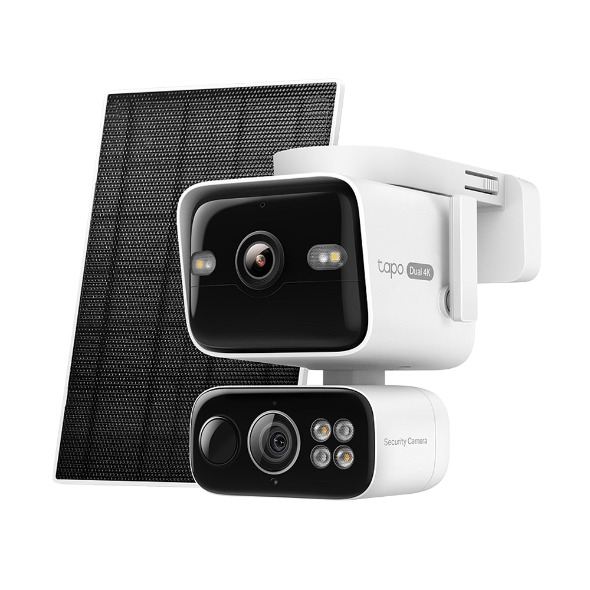
Best Solar Outdoor Dual-Lens Camera: Tapo C675D Kit
Covering a large property often means choosing between a wide view and a detailed one. The Tapo C675D Kit handles both at once, with dual 4K lenses in a solar-powered package.
The fixed wide-angle lens covers a 169° field of view, keeping a broad area of your property in frame. The pan/tilt telephoto lens adds 360° tracking with 18x digital zoom, automatically locking onto motion detected by the fixed lens. Both lenses use Starlight Color Night Vision, so you still get color coverage from both views after dark.
24/7 Continuous Capture records still images at customizable intervals of one to 60 seconds to a microSD card (sold separately), filling in the gaps between motion-triggered events. The solar panel supports daily operation with just 90 minutes of direct sunlight, based on standard environmental conditions and specified working scenes. Actual required sunlight time may vary. The built-in battery provides up to three months per charge, based on Tapo testing. IP65 rated, this camera is also compatible with Samsung SmartThings and IFTTT. Check product details for full compatibility.
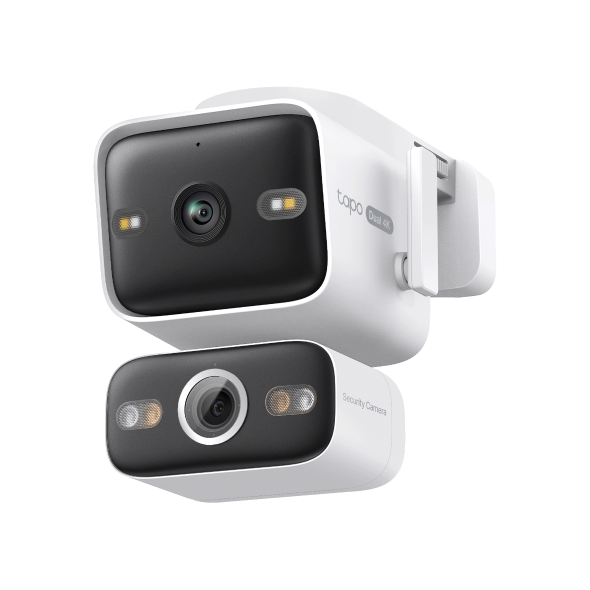
Best Wire-Free Outdoor Dual-Lens Camera: Tapo C645D Kit
Some locations need dual-zone coverage but have no outlet nearby. The Tapo C645D Kit is built for exactly that: monitoring two separate areas from one solar-powered device, with no cable runs required.
It pairs a fixed 2K wide-angle lens with a 165° field of view alongside a 2K pan/tilt telephoto lens. The wide-angle lens holds the full scene in frame while the telephoto lens tracks and zooms independently. Synchronized Smart Tracking means that when the fixed lens detects motion, the telephoto lens automatically pivots and zooms in on the source. One-Tap Smart Focus lets you tap anywhere in the wide-angle live view to direct the telephoto lens to that point.
The camera runs on solar power. Under standard environmental conditions and specified working scenes, one hour of direct sunlight is enough to keep it running through the day, though actual sunlight requirements may vary. The backup battery lasts up to four months per charge under typical usage. Versatile night-vision modes let you choose full color with spotlights or infrared for discreet, power-efficient monitoring in low-light conditions. The camera is IP65-rated and works with Samsung SmartThings. Check product details for full compatibility.
Best Wired Outdoor Dual-Lens Camera: Tapo C575D
The Tapo C575D is a wired dual-lens option: dual-zone coverage with no battery management. The fixed lens covers a wide 170° field of view in 4K, while the 8mm telephoto pan/tilt lens provides 360° coverage with 18x digital zoom. Synchronized Smart Tracking automatically pivots the telephoto lens to follow detected subjects, and One-Tap Smart Focus lets you redirect it anywhere in the wide-angle view on demand.
Smart Night Vision offers three options: full-color with spotlights, infrared for discreet black-and-white monitoring, or a Smart Mode that switches automatically based on AI-driven light detection. Free AI detection covers people, pets, and vehicles, plus line-crossing and tamper detection, which is a broader set than most outdoor cameras.
IP66-rated and PoE-compatible, the C575D runs on a standard DC adapter or a single Ethernet cable that handles both power and network data. This is useful for longer runs or locations with unreliable Wi-Fi. For households looking for one of the best home security cameras with dual-zone coverage and zero battery management, this is a strong option. It works with Samsung SmartThings. Check product details for full compatibility.
Find the Right Camera for Your Outdoor Setup
There's no single answer for every property. The right outdoor camera depends on where it needs to go, how it can get power, and what you actually need it to see.
Wired cameras like the C560WS and C575D are a straightforward fit where outlet access is available: reliable, detailed, and no battery levels to track. Solar options like the C660 Kit, C675D Kit, and C645D Kit open up spots that would otherwise require running cables. And if you need to monitor two zones at once, a dual-lens camera often does the job of two separate cameras from a single mounting point.
Full-featured outdoor monitoring (live view, motion alerts, AI detection, and local storage) doesn't require a monthly subscription. Explore Tapo's outdoor home security camera lineup to compare models and find the right fit for your home.
Frequently Asked Questions
What is the best outdoor security camera for home use?
It depends on your setup. For high-traffic locations with outlet access, a wired 4K camera gives you uninterrupted recording and sharp detail at a distance. For spots without power, a solar-powered or battery-powered camera can be placed without cable runs. A pan/tilt or dual-lens model is worth considering if you need to cover a large yard or two separate areas from one device.
Do outdoor security cameras need a subscription?
No. Most outdoor security cameras provide live viewing, motion detection alerts, and local microSD storage (sold separately) without a subscription. Tapo cameras include all core features at no ongoing cost. An optional subscription like Tapo Care adds extended cloud video history.
What's the difference between wired and wireless outdoor security cameras?
A wired camera gets its power from an outlet and draws on that connection for uninterrupted recording. A wireless camera transmits video over Wi-Fi, but it may still need a power cable. "Wireless" refers to how it sends footage, not how it stays charged. A wire-free camera is one running on battery or solar power. That distinction matters most when you're planning where to mount the camera.
How do I choose an outdoor camera for my home?
Start with the location. Does it have outlet access? If yes, a wired camera keeps things simple. If not, solar or battery is the way to go. If there's sun exposure at that spot, solar is the lower-maintenance choice. From there, think about coverage: a single entry point usually works fine with a fixed-lens camera, while a large yard or wide area benefits from pan/tilt capability and higher resolution. Smart home platform compatibility is worth checking before you commit.
Can outdoor security cameras work without Wi-Fi?
Most outdoor cameras need a Wi-Fi connection to send alerts and enable live viewing through an app. Without it, real-time monitoring and notifications won't work. Some cameras can still record locally to a microSD card (sold separately) even when offline, so footage is available to review later.