


Both solar and battery security cameras are wireless and easy to install, without running cables or hiring a professional. The difference is how they stay powered. A solar security camera uses a solar panel to keep its battery charged from sunlight, either with the panel integrated into the camera body, or mounted separately to capture sunlight from the best available spot. A battery camera relies on a rechargeable battery that is manually charged through a standard power outlet.
Choosing between these two options comes down to where you plan to mount your camera and how much ongoing maintenance you're comfortable with. This article walks through both options side by side, so you can see clearly which one fits your home setup and needs.
Key Takeaways
- Both solar and battery security cameras are wire-free. The difference is how each one stays charged.
- Solar cameras work best in spots with reliable sunlight, like sunny driveways, open eaves, and south-facing walls. Many Tapo solar cameras support separated panel installation, so the camera can go where you need coverage while the panel is positioned to catch the best available light.
- Battery cameras offer more placement flexibility, including shady corners, covered porches, or a side of the house that doesn't get much sunlight.
- Solar reduces long-term maintenance; battery cameras require periodic recharging, but cost less upfront.
- Using smart motion zones on a battery camera can significantly extend battery life between charges.
What Is a Solar Security Camera?
A solar security camera is a wireless camera with an attached solar panel that slowly and continuously charges a built-in battery during daylight hours. In most cases, consistent partial sunlight is enough to keep the battery topped up for regular daily use.
Because the panel needs sunlight to operate, placement matters. A solar-powered security camera performs best when the panel gets direct sunlight for several hours each day. Many Tapo solar cameras support both integrated and separated installation, so the panel and camera don't have to be mounted in the same spot. This gives you the flexibility to position the camera where you need coverage and angle the panel toward the best available light.
Shaded walls, covered entryways, and north-facing spots will limit how much charge the panel collects if the panel is mounted there. With a separated setup, you can often work around these constraints.
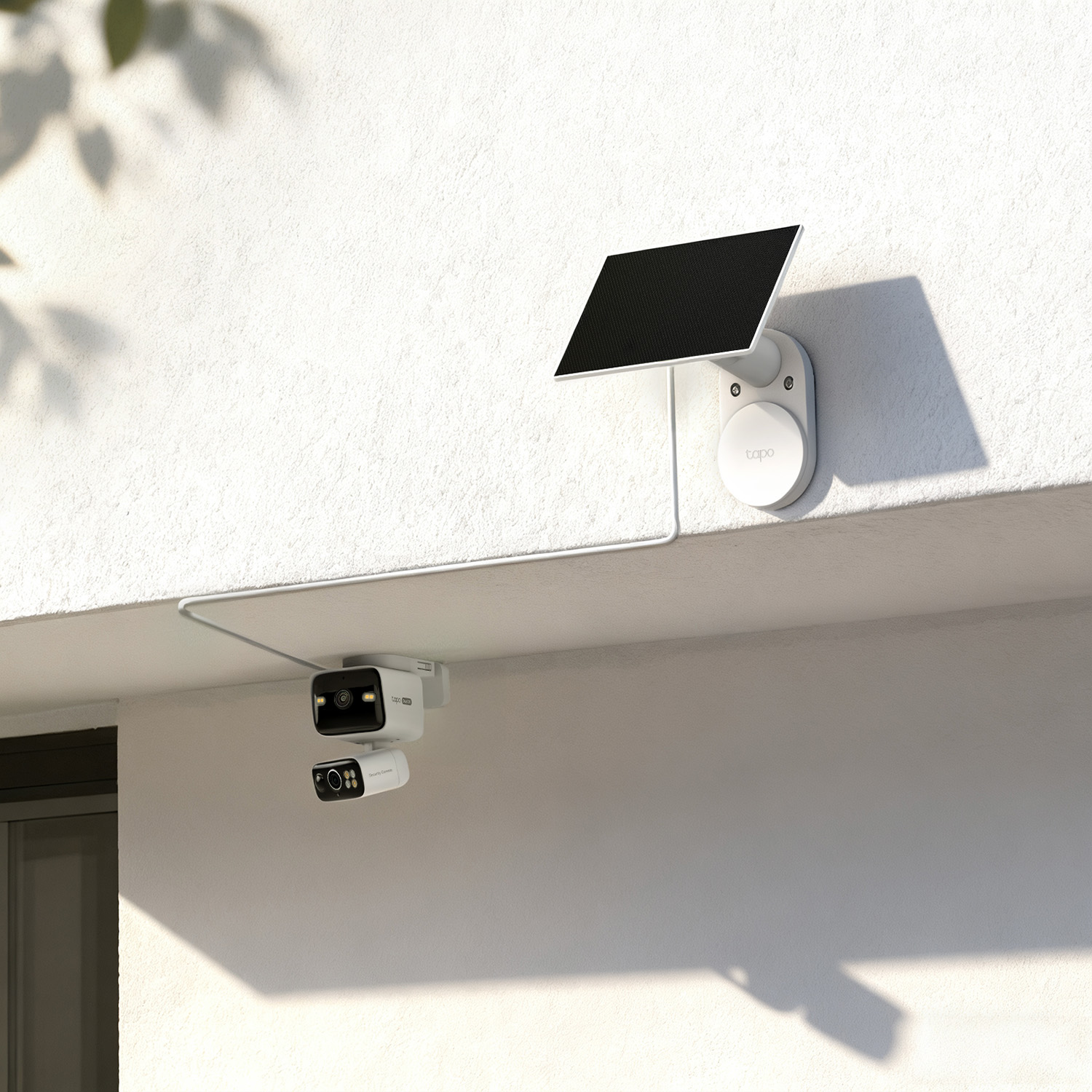
What Is a Battery Security Camera?
A battery-powered security camera runs entirely on a rechargeable battery. There's no panel attached, and the battery charges via USB when needed. How often charging is required depends on how active your camera's location is and which features are running.
The main advantage of a battery-operated security camera is placement freedom. Without any sunlight requirement, you can mount it on a shaded wall, a covered porch, inside a garage, or anywhere else a panel wouldn't get reliable light. When sunlight isn’t viable, battery cameras might be the best option.
Solar vs. Battery Security Cameras: The Key Differences
A closer look at how solar and battery security cameras differ on the factors that suit your preferences.
|
Solar Camera |
Battery Camera |
|
|
Power Source |
Solar panel trickle-charges built-in battery |
Rechargeable battery, charged manually via USB or swap |
|
Maintenance |
Low: panel maintains charge automatically |
Periodic recharging required |
|
Best Placement |
Sunny driveways, open eaves, south-facing walls |
Shaded yards, covered porches, garages, indoor spaces |
|
Performance in Low Sunlight |
Can dip during extended overcast periods or winter |
Consistent regardless of weather or season |
|
Long-Term Convenience |
Higher upfront; lower ongoing effort |
Lower upfront; requires regular recharging |
The main trade-off is this: solar cameras are lower maintenance, while battery cameras give you more flexibility upfront without depending on the weather. Neither is universally better - the right choice depends on where you're planning to mount the camera.
When Solar Makes More Sense?
For areas with strong, consistent sunlight, such as a front driveway, high eaves, a south-facing wall, or an open backyard, solar is worth considering first.
Solar is typically the better choice when you can position the panel in a spot with consistent sunlight, whether that's integrated with the camera or mounted separately nearby. Because the panel continuously recharges the battery from sunlight, a well-placed solar camera can run 24/7 with little maintenance. Once mounted and connected, it largely takes care of itself, making it practical for hard-to-access spots like roofline corners, remote outbuildings, or off-grid locations.
When Battery Is the Better Choice?
For covered porches, shaded side yards, north-facing walls, interior garages, and areas with significant tree cover, a battery-powered security camera is often the more practical fit.
Battery cameras give you the most placement flexibility. With no sunlight requirement, placement is determined by where you need coverage, not where the light falls.
The trade-off is maintenance. Battery cameras require regular manual recharging, and how long a charge lasts depends on the camera's activity, which features are running, and the environmental conditions. One effective way to extend time between charges is to set up smart motion zones, which limit recording to specific areas and reduce unnecessary triggers.
Keep in mind that the best battery-powered security camera for your setup is the one that fits the location you actually need to cover, not just the one with the longest spec-sheet battery estimate.
Do Solar Security Cameras Work Well?
A solar security camera works well when it's placed in the right spot. Performance is closely tied to location, so a camera that gets several hours of daily sunlight will maintain a consistent charge and record reliably day after day.
It helps to understand how the panel works. Most solar cameras use a small panel to maintain the battery rather than fully charge it from scratch. That means consistent partial sunlight — not peak summer sun — is enough to keep it running. A few hours of light each day is typically all it takes.
Where performance can slip is in heavily shaded locations or during extended stretches of overcast weather. In those conditions, the panel may not collect enough light to keep up with daily use, and the battery can gradually drain.
What Are the Disadvantages of Solar Cameras?
Solar cameras work well in the right setting, but there are three limitations worth considering before you buy.
First, the panel needs consistent sunlight to maintain a reliable charge. With a separated installation, you can position the panel independently to catch the best available light, even if the camera itself is in a shadier spot. That said, if neither the camera location nor any nearby spot gets reliable sunlight, a battery camera may be the better fit.
Next, performance can be less reliable in winter or during extended cloudy periods. In regions with long grey seasons, a solar camera may not collect enough light to maintain a full charge, especially with heavy use.
Finally, solar cameras typically cost a little more upfront than comparable battery-only models. The panel and reduced maintenance they provide can come at an initial premium. The cost tends to balance out over time, though you may want to factor in this higher upfront investment.
Does a Solar Camera Work Without Wi-Fi?
For solar security cameras, the panel only powers the camera, so Wi-Fi is still required for live viewing, motion alerts, and app access.
Some cameras support local storage on a microSD card (sold separately), which allows recording to continue even without an Internet connection. You won't get remote alerts, but footage will still be saved locally.
The Best Tapo Solar and Battery Security Cameras
Tapo offers wireless cameras in both solar and battery options, so you can choose what works best for your setup. Here's a quick look at where each one fits best.
Best Solar Security Cameras from Tapo
If solar suits your location, Tapo offers a range of options depending on how much coverage you need. The Tapo C660 Kit is a 4K pan-tilt solar camera built for large yards and wide driveways. It rotates to follow movement and captures a broad view without repositioning. For most outdoor locations, the Tapo C460 Kit is a versatile all-rounder that balances performance and value.
If you're just getting started with solar cameras, the C402 Kit is an accessible entry point worth exploring. You can browse the full range of Tapo solar security cameras to find the right option for your space.
Best Battery Security Cameras from Tapo
For locations where solar isn't practical, Tapo's battery-powered options give you full wire-free flexibility. The Tapo C465 is a capable battery-powered outdoor security camera for covered porches, shaded side yards, garages, and more. For a broader look at wire-free options across different placement needs, the wireless outdoor security camera collection includes models suited to many outdoor setups.
Find the Right Camera for Your Setup
The choice between solar and battery comes down to one main question: how much sunlight does your mounting location actually get? Sunny driveways, open eaves, and south-facing walls are good candidates for a solar security camera. Shaded walls, covered porches, and garages are better served by a battery-operated security camera.
Both types give you the flexibility of a wire-free install. It's just a matter of matching the power source to where you need the camera to go. If you're ready to explore your options, Tapo's solar security cameras and wireless outdoor cameras give you a good starting point for both setups. You can also browse wire-free cameras with remote access to see the full range of options.
Frequently Asked Questions
Do solar security cameras work well?
Yes, when placed in a spot with reliable sunlight. Performance is closely tied to location: a camera with several hours of daily light will maintain its charge consistently. In heavily shaded spots or during extended cloudy periods, recording continuity can be affected.
How long do solar security camera batteries last?
The battery in a solar camera is continuously maintained by the solar panel, so in a well-placed location it can last indefinitely without manual recharging. In heavily shaded spots or during extended cloudy periods, the battery will drain more quickly and may eventually need a manual top-up.
Can a solar security camera charge on a cloudy day?
Yes, but at a reduced rate. Solar panels can collect diffuse light on overcast days, but they generate significantly less charge than on sunny days. A camera in a mostly shaded spot during a long cloudy stretch may see battery levels drop over time.
Do battery security cameras work in cold weather?
Battery cameras continue to work in cold weather, though very low temperatures can temporarily reduce battery capacity. Most cameras are designed to operate within a standard outdoor temperature range. In extreme cold, you may find the battery drains a little faster than usual.
Is a solar camera worth it over a battery camera?
It depends on your location. If you're mounting in a sunny spot and want to avoid regular recharging, solar is worth the slightly higher upfront cost. If your location is shaded or sunlight is inconsistent, a battery camera will give you more reliable performance with fewer placement constraints.