Megapixels vs. Resolution: What They Mean for Security Cameras
Megapixels vs. resolution: these two terms appear on nearly every camera spec sheet, but most product listings don't explain what they mean or how they differ. You'll find them listed side by side, often without context, and it's not obvious which one tells you more about what the camera's footage will actually look like.
Megapixels and resolution are related, but they measure different things. Understanding both and the connection between them makes it much easier to compare security cameras and choose the right one for your home.
This guide defines each term in plain language, explains how they work together, and connects the numbers to what you'll see in your footage.
Key Takeaways
- A megapixel equals one million pixels. A camera's megapixel count tells you the total number of pixels its sensor captures in each frame.
- Resolution describes how those pixels are arranged, expressed as width by height (for example, 2560×1440). Together, width and height determine the total pixel count and the shape of the image.
- Multiply a resolution's width by its height to get the pixel count. Divide by one million to get the megapixel number: 2560×1440 equals roughly 3.7 megapixels.
- For security cameras, resolution is the more practical number to compare. Common options are 1080p (2MP), 2K (around 3 to 4MP), and 4K (8MP).
- Higher resolution means sharper footage and more visible detail when zooming in on faces, license plates, or distant activity.
What Are Megapixels?
A megapixel (MP) is one million pixels. When a camera lists a megapixel count such as 2MP, 4MP, or 8MP, it's telling you the total number of pixels the image sensor captures in each frame.
To understand what that means, it helps to know what a pixel is. A pixel is the smallest unit of a digital image: a tiny square that records a single value of color and light. Millions of them combine to form a complete picture.
A higher megapixel count means the sensor captures more data per frame. More data creates more detail in the image, but megapixels alone don't determine overall image quality. Lens quality, sensor size, and low-light performance all play a role, too.
What Is Camera Resolution?
Camera resolution describes how pixels are arranged in an image. It's typically expressed as two numbers, width by height, representing how many pixels run across and down the frame (for example, 2560×1440).
A camera with 2560×1440 resolution captures 2,560 pixels across and 1,440 pixels down. The larger each number, the more detail the image contains. When you zoom into footage, higher resolution means you can still make out faces, license plates, and other details that would blur at lower resolutions.
Here are the common resolution names you'll see on security camera spec sheets, along with their pixel dimensions:
- 1080p Full HD (Full High Definition): 1920×1080
- 2K QHD (Quad High Definition): 2560×1440
- 4K UHD (Ultra High Definition): 3840×2160
Each step up captures significantly more detail, especially when viewing footage from cameras covering larger outdoor areas.
How Are Megapixels and Resolution Related?
Megapixels and resolution describe the same image data, just from different angles. Resolution tells you how pixels are arranged. Megapixels tell you the total count.
To get from resolution to megapixels, multiply the width by the height, then divide by one million. A 1920×1080 image contains 2,073,600 pixels, which rounds to approximately 2 megapixels. A 3840×2160 image contains 8,294,400 pixels, or approximately 8 megapixels.
You'll sometimes see cameras listed by megapixels rather than resolution name. The Tapo C310 is a useful example: it's listed at 3 megapixels, which corresponds to a resolution of 2304×1296, sharper than 1080p but below 2K QHD.
Here's how common megapixel counts map to the resolutions you'll see on security camera listings:
|
Megapixels |
Resolution |
Pixel Dimensions |
Common Label |
|
2MP |
Full HD |
1920×1080 |
1080p |
|
3MP |
QHD |
2304×1296 |
2K (3MP) |
|
4MP |
QHD |
2560×1440 |
2K (4MP) |
|
8MP |
UHD |
3840×2160 |
4K |
For security cameras, resolution is the more actionable number. It tells you directly what the footage will look like.
What Megapixels and Resolution Mean for Image Quality
Higher resolution means the sensor captures more pixels per frame. In practice, that translates to sharper footage, more visible detail when you zoom in, and better coverage across larger distances.
For security cameras specifically, this matters most when you need to identify something at a distance, such as a face, a license plate number, or the details on a package. A 4K camera watching a long driveway gives you much more workable detail than a 1080p camera covering the same area.
Other factors also affect final image quality: lens aperture, sensor size, and night-vision capability all shape how the footage looks, especially in low-light conditions. Megapixels and resolution are the starting point, but they're not the whole picture.
It's also worth noting that what counts as "enough" resolution varies depending on the device. A security camera monitoring a wide outdoor area has different requirements than a smartphone camera designed for close-range photos. That's why the next section focuses specifically on how to match resolution to where and how you're using the camera.
Choosing the Right Megapixels and Resolution for Your Security Camera
The right resolution depends on three things: where you're placing the camera, how large the area is, and how much detail you need to capture at a distance. A camera covering a small indoor room has different needs than one watching a long driveway or a wide backyard.
Use this table as a starting point when matching resolution to your setup:
|
Camera Location |
Recommended Resolution |
Megapixels |
Why It Works |
|
Small indoor room (nursery, hallway) |
1080p Full HD |
2MP |
Subjects are close; detail is sufficient for clear identification |
|
Front door or single entry point |
2K QHD |
3–4MP |
Captures facial features and visitor activity clearly |
|
Driveway or side yard (medium distance) |
2K QHD |
3–4MP |
Strong detail across a moderate area; flexible for zoom review |
|
Large yard, wide outdoor area |
4K UHD |
8MP |
Maximum detail at distance; identify vehicles and people clearly |
|
Multiple entry points or large property |
4K UHD |
8MP |
Retains clarity even when zooming into specific areas of wide-angle footage |
As a general rule, the farther away subjects are from the lens, and the more you'll rely on zooming into footage, the more resolution matters.
Tapo Security Cameras: Resolution and Megapixels That Deliver
Tapo's camera lineup includes all common resolution tiers, with each camera matched to specific placement needs and coverage areas. The following models illustrate how resolution connects to how you'll use each camera in real life, from small indoor rooms to wide outdoor properties.
All models support local storage via a microSD card (sold separately), with Tapo Care cloud storage available as an optional upgrade. Most models also include free AI detection for people, pets, and vehicles, with no subscription required for core features.
1080p (2MP): Tapo C206
The Tapo C206 is a pan/tilt camera with 1080p Full HD resolution and a 360° horizontal and 146° vertical range of coverage. That wide sweep makes it well-suited for smaller indoor spaces like living rooms or nurseries, where you want one camera to cover the whole room rather than a single fixed angle.
It includes color night vision with built-in spotlights, AI detection for people and baby cries, Smart Motion Tracking, and two-way audio. For households with young children, the baby cry detection means you can set the camera in a nursery and get alerted without keeping a separate monitor nearby.
2K (4MP): Tapo C120
The Tapo C120 is rated for both indoor and outdoor use and features 2K QHD resolution. The jump from 1080p to 2K means noticeably sharper footage when you need to review an event, whether that's reading a package label left at the door or identifying a visitor's face in playback.
Its starlight sensor keeps footage vibrant in low-light conditions, and built-in dual spotlights add visibility when motion is detected after dark. The magnetic base makes it easy to reposition as your monitoring needs change, and an IP66 weatherproof rating means it holds up outdoors through rain and dust year-round.
2K+ (4MP): Tapo C425
The Tapo C425 brings 2K QHD resolution to locations where running power simply isn't an option. It's fully wire-free, with a battery rated for up to 300 days per charge under typical usage, so it can go on a fence post, a shed wall, or a corner of the yard that a plug-in camera couldn't reach.
Its 142° super-wide field of view covers more of a scene from a single mounting point, which makes it a practical pick for wide outdoor areas like side yards or back gates where a narrower camera would leave gaps. If the placement gets regular sun, a Tapo solar panel (sold separately) keeps the battery topped up without manual recharging.
4K (8MP): Tapo C675D Kit
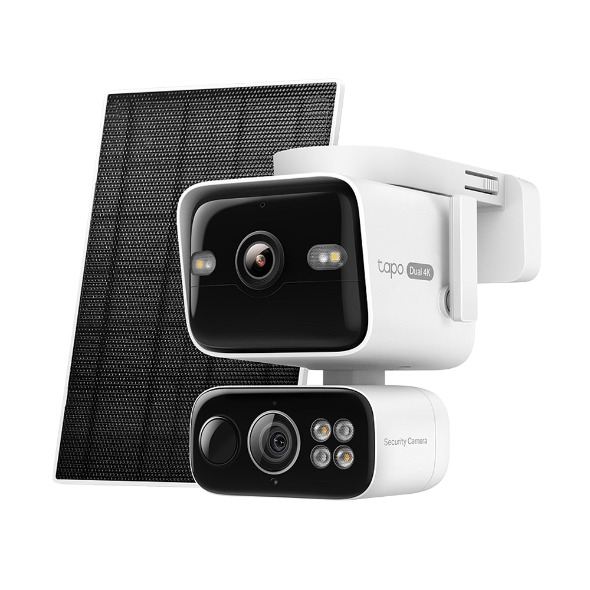
The Tapo C675D Kit is a solar-powered dual-lens camera designed for larger outdoor properties. Both lenses capture at 4K resolution, giving you maximum detail across wide areas and when zooming into specific activity in reviewed footage.
The first lens covers a fixed 169° ultra-wide field of view. The second is a pan/tilt lens with 360° horizontal coverage that automatically locks onto and tracks motion detected by the wide lens. For a property with a long driveway or a large front yard, that combination means you can read a license plate or identify a face even when the action happens at a distance.
The camera runs on solar power, with a backup battery supporting up to three months per charge under typical usage. It also supports 24/7 Continuous Capture, which records still images at customizable intervals of one to 60 seconds to a microSD card (sold separately), giving you a visual record between motion-triggered events. IP65-rated for year-round outdoor use.
4K (8MP): Tapo C460
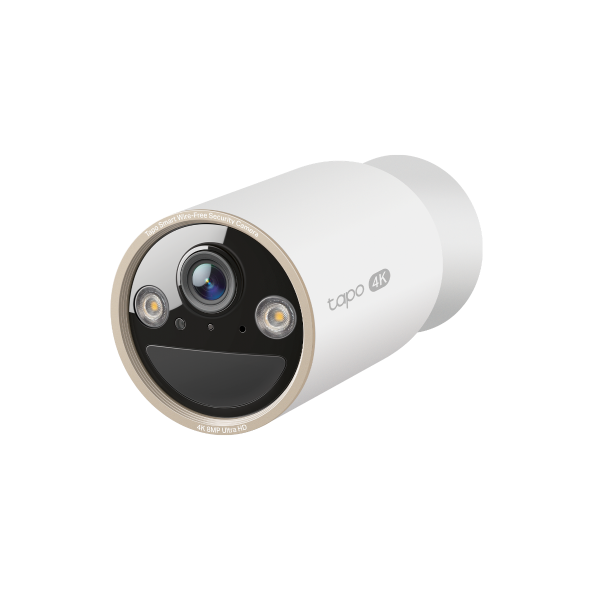
The Tapo C460 is a wire-free 4K battery outdoor camera. At 8MP, it captures the same level of detail as the C675D Kit in a single-lens format, making it a strong fit for locations where you need high-resolution coverage from a fixed angle.
Its starlight sensor delivers full-color footage in low-light conditions, so a dark driveway or unlit backyard corner stays visible rather than just triggering a motion alert. Customizable activity zones let you focus detection on the areas that matter, cutting down on unnecessary notifications. The battery supports up to 200 days of operation per charge based on Tapo laboratory tests, and the camera is compatible with an optional Tapo solar panel for locations that get consistent sun. IP66-rated for outdoor use.
For the full range of high-resolution options, explore Tapo's 4K camera collection.
Find the Right Resolution for Your Setup
Megapixels and resolution are related but distinct. Megapixels give you the total pixel count; resolution tells you how those pixels are arranged and what the footage will actually look like. For security cameras, resolution is the key factor, and the right resolution depends on where your camera is going and how far away you need to see clearly.
A 1080p camera handles small indoor rooms well. Step up to 2K for front doors, entryways, and medium outdoor areas. Choose 4K when you're covering large yards, long driveways, or any location where identifying details at a distance is a priority.
Explore the full Tapo home security collection to compare cameras by resolution, power source, and placement, and find the model that fits your home's specific setup.
Frequently Asked Questions
What is the difference between megapixels and resolution?
Megapixels measure the total number of pixels a camera sensor captures: one megapixel equals one million pixels. Resolution describes how those pixels are arranged as width by height (for example, 1920×1080). They're related: multiply the resolution dimensions together and divide by one million to get the megapixel count.
What does MP mean on a security camera?
MP stands for megapixel. On a security camera spec sheet, it tells you the total number of pixels the camera sensor captures in each frame. A 4MP camera captures four million pixels per frame, more than a 2MP camera, resulting in sharper, more detailed footage.
How many megapixels is good for a security camera?
It depends on where you're placing the camera and how much detail you need at a distance. For small indoor spaces, 2MP (1080p) is usually sufficient. For front doors and medium outdoor areas, 3–4MP (2K) gives you a noticeable improvement. For large outdoor areas where you need to identify faces or license plates at a distance, 8MP (4K) delivers the most detail.
Are more megapixels always better for security cameras?
Not always. Higher megapixels mean sharper footage and more detail when zooming in, but they also require more storage. For a small indoor room where subjects are close to the camera, the difference between 2MP and 4MP footage may not be meaningful in daily use. Match the resolution to where the camera is going and what it needs to capture; that matters more than choosing the highest number available.
What resolution should I look for in a home security camera?
Start with where the camera will be placed. For indoor rooms and smaller spaces, 1080p Full HD (2MP) works well. For entryways, front doors, and moderate outdoor areas, 2K (3–4MP) is a strong all-around choice. For large outdoor areas or anywhere you need to identify details at a distance, 4K (8MP) gives you the most flexibility when reviewing footage